Drum Programming: Making Patterns That Knock

Three jobs, sixteen boxes
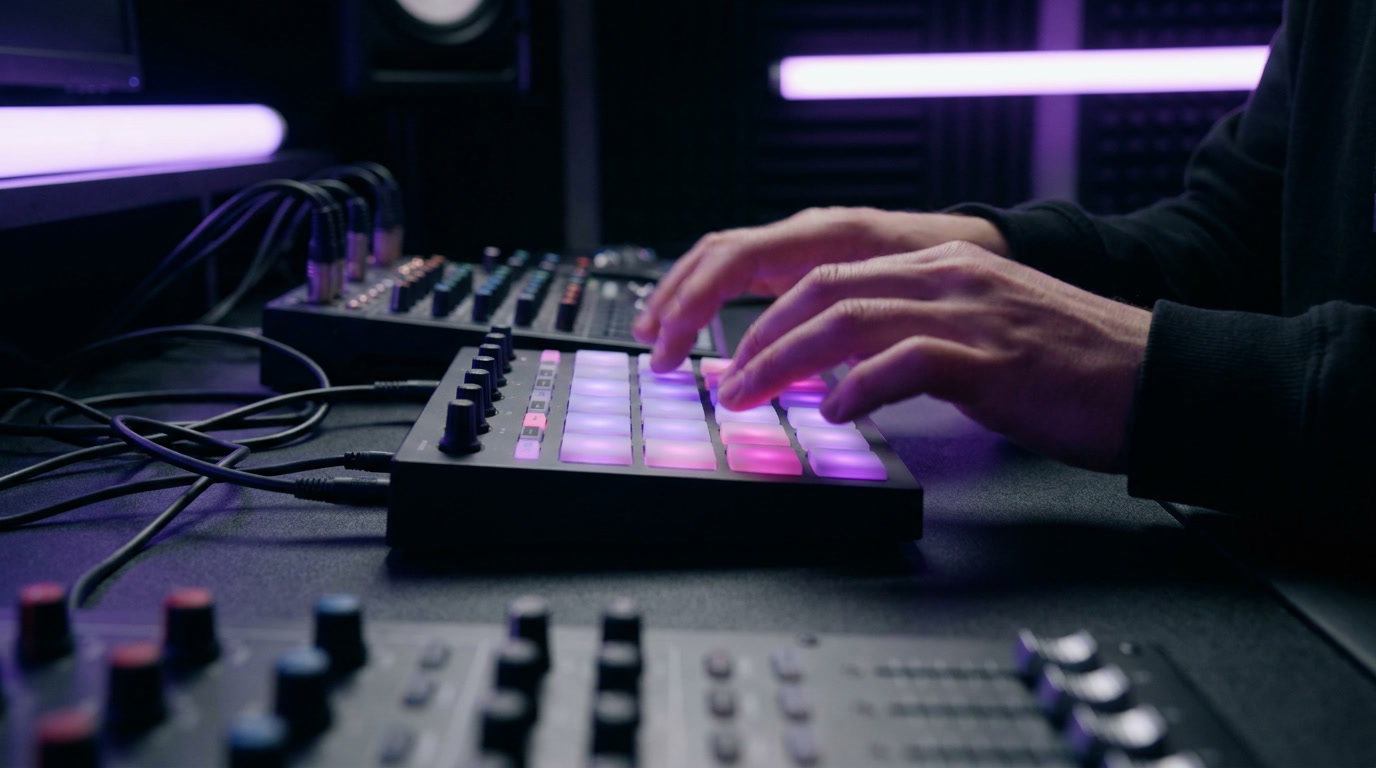
Strip drum programming to its skeleton and there are three jobs: the kick states the pulse, the snare answers it, and the hats stitch the space between. Almost every pattern you love, from boom bap to house, is a different conversation between those three, drawn on a 16-step grid, one bar of sixteenth notes.
Learn to hear the grid and you can reverse-engineer anything. Step 1 is beat one. Steps 5, 9, and 13 are beats 2, 3, and 4. Everything else is the spice rack.
Start boring on purpose
Write the vanilla version first: kick on 1 and 9, snare on 5 and 13, hats on every even step. This is the rock-basic backbeat and it sounds like a metronome with opinions. Good. Now every change you make is a decision you can hear, instead of a random pile you cannot debug.
From the vanilla base, genre is mostly kick placement:
- Hip-hop and boom bap (85 to 95 BPM): keep snares on 5 and 13, then move the second kick around, try steps 8, 10, or 11, until it limps in a way you like.
- Trap (130 to 150 BPM, half-time): snare only on step 9. Kicks cluster in twos and threes with long gaps. Hats run constantly, with bursts of double-speed.
- House (120 to 128 BPM): kick on 1, 5, 9, 13, open hat on the offbeats between them, clap layered with the snare. The genre is practically a preset; the artistry is in the sounds and the swing.
The three humanizers
A perfect grid sounds like a spreadsheet. Human drummers are consistently inconsistent, and you can fake that with three tools:
- Velocity. This one is 80 percent of the feel. Make hat hits alternate loud-soft-medium-soft instead of uniform. Drop ghost snare hits, very quiet ones on off-steps like 7 or 15, at maybe 30 percent volume. Ghost notes are the difference between a pattern and a groove.
- Swing. Delay every even-numbered sixteenth by a hair, most software calls it swing or shuffle, 55 to 62 percent is the musical zone. Straight sixteenths march; swung sixteenths strut.
- Micro-timing. Push the snare 10 to 20 milliseconds late and the beat feels relaxed and heavy. Nudge hats slightly early and it feels eager. Tiny numbers, huge attitude.
An old mentor made me program the same pattern five ways, changing only velocities, before he would talk about anything else. Meanest, most useful afternoon of my twenties.
Arrangement: patterns need a life cycle
A great bar looped for three minutes becomes wallpaper. Give the pattern a life cycle: every 4 bars, vary the last two steps, drop a kick or add a quick snare double. Every 8 bars, a proper fill or a one-beat mute. New song section, change the hat behavior, closed hats in the verse, open hats in the hook is the oldest trick in the book because it keeps working.
And subtraction beats addition: muting the kick for the two bars before a chorus creates more excitement than any riser.
Practice like a producer
Do not practice in a vacuum. Take a beat you admire, count its grid, and clone it step by step, kick placement first, then snare, then hats, then velocities. You will find at least one hit in a place you never would have guessed; that surprise is the lesson. Volmix works fine as a study library for this, loop a beat from a genre you do not make and map it on paper.
Clone ten beats across three genres and something shifts: you stop copying patterns and start speaking the language. After that, the grid is just sixteen boxes waiting for your accent.
Marco Vidal
Marco has produced and mixed records for fifteen years, from bedroom demos to chart singles. He writes about beats, sound design and mixing — always with real numbers and zero mystery-making.
All articles by Marco Vidal